How to play Hong Kong Mahjong, step by step
Hong Kong Mahjong is a four-player game of drawing and discarding until one player builds four sets and a pair. This walkthrough follows one real hand in Table Mahjong, with a screenshot for each step, so you can play your first game in about ten minutes.
Prefer to learn at the table? The tutorial walks you through a hand, then three bots wait for you.
▶ Start the TutorialOr play a solo hand now
The goal in one sentence
Be the first to turn your 13 tiles, plus one more, into four sets and a pair. A set is a Chow (three in a row in one suit, such as 3-4-5 Dots), a Pong (three of a kind) or a Kong (four of a kind). The more valuable the hand, the more faan it scores.
The tiles are three suits numbered 1 to 9 (Characters, Bamboo and Dots), four winds, three dragons, and eight flowers and seasons that are set aside as bonuses. The rules guide has the full tile list.
Illustrated walkthrough
-
Open a table and pick how to play
Open tablemahjong.com in any browser. Choose Solo to play three bots, Private Room to invite friends with a link or four-letter code, or Quick Match for a public table. New players can take the animated Tutorial first.
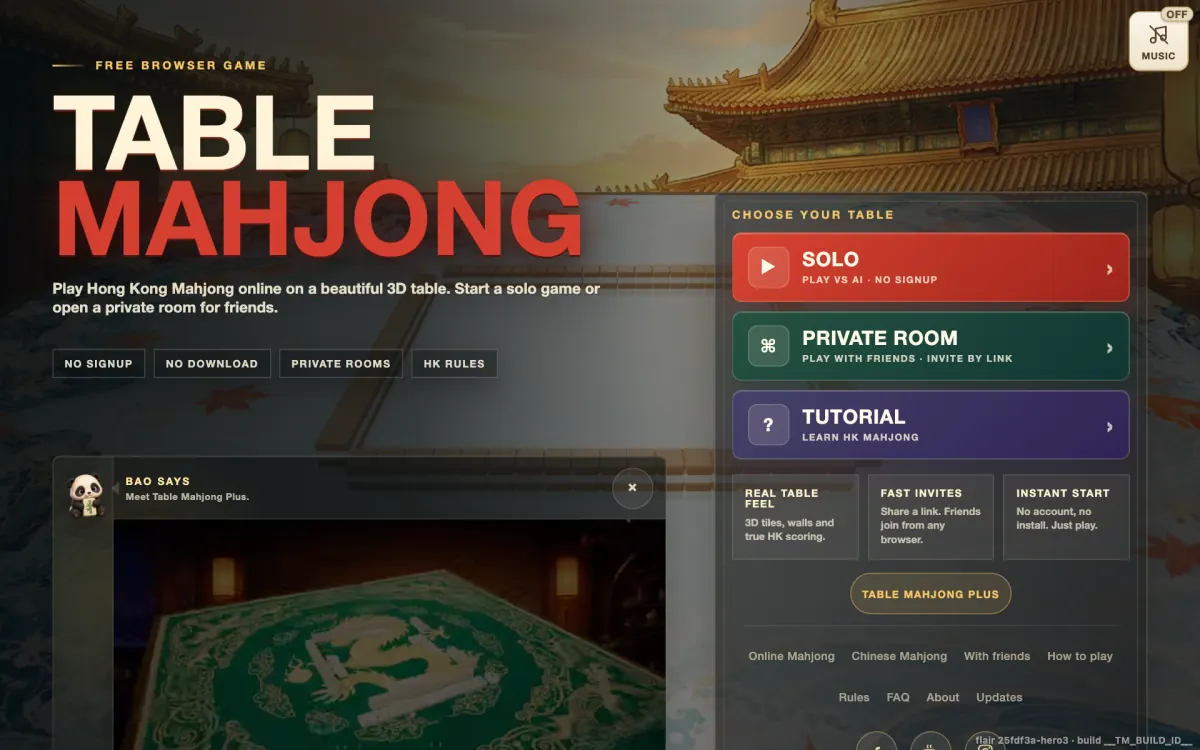
The home screen. Solo starts a hand straight away; no signup or download. -
Check your seat and your 13 tiles
Everyone gets 13 tiles and the dealer, always East, gets 14 and discards first. Your tiles sit along the bottom. The header shows your seat wind, who is dealing, the tiles left in the wall and the faan you already hold.
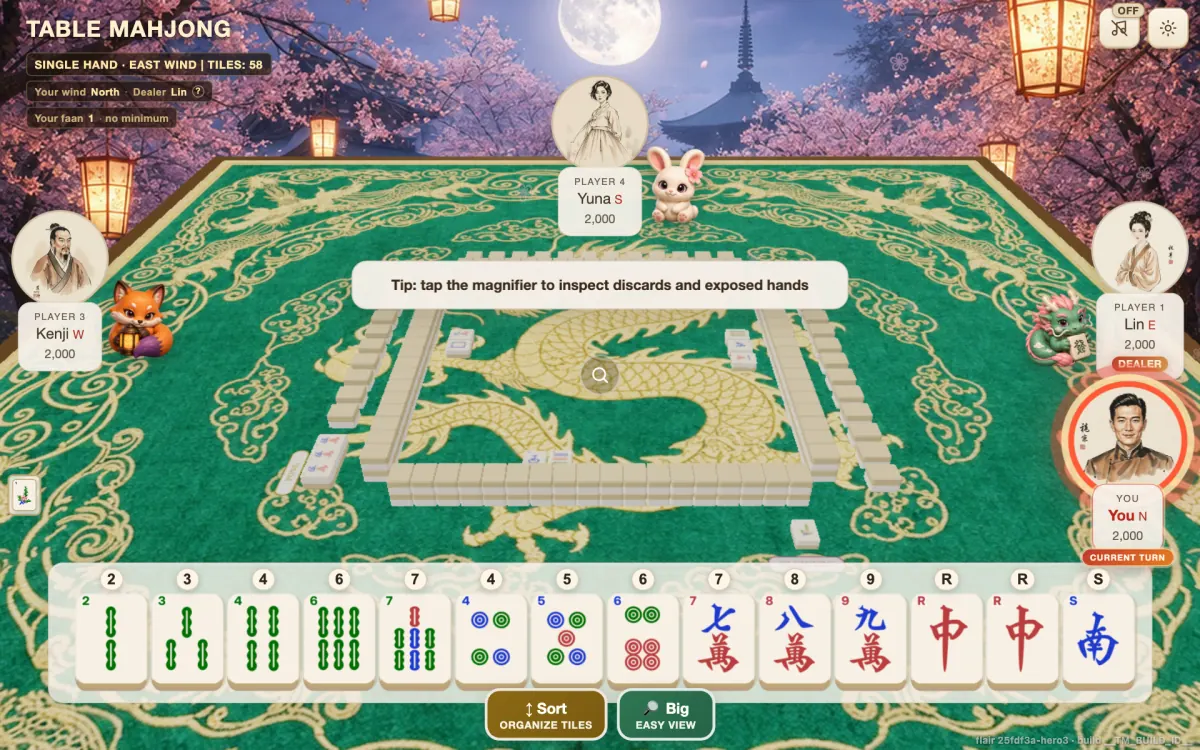
Your rack at the bottom, opponents left, top and right. Flowers you draw are set aside and replaced for you. -
Draw a tile, then discard one
On your turn you draw from the wall, so you hold 14 tiles. Keep the tiles that work toward sets and discard one face up into the middle. Use Sort to group your tiles by suit.
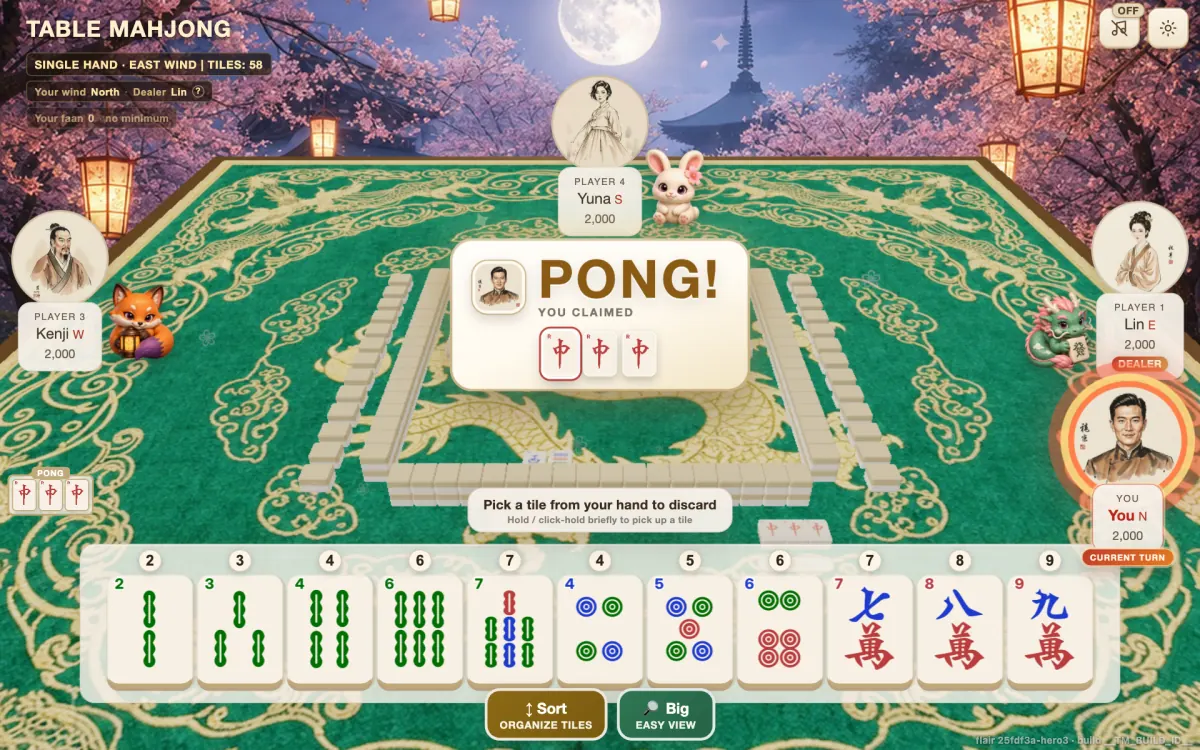
After every draw or claim the game prompts you to pick one tile to discard. -
Claim a Pong when you hold a pair
If anyone discards a tile you hold two of, a Pong button appears. Claiming it makes three of a kind, shown face up, and it becomes your turn to discard. Skip if the set does not help your hand.
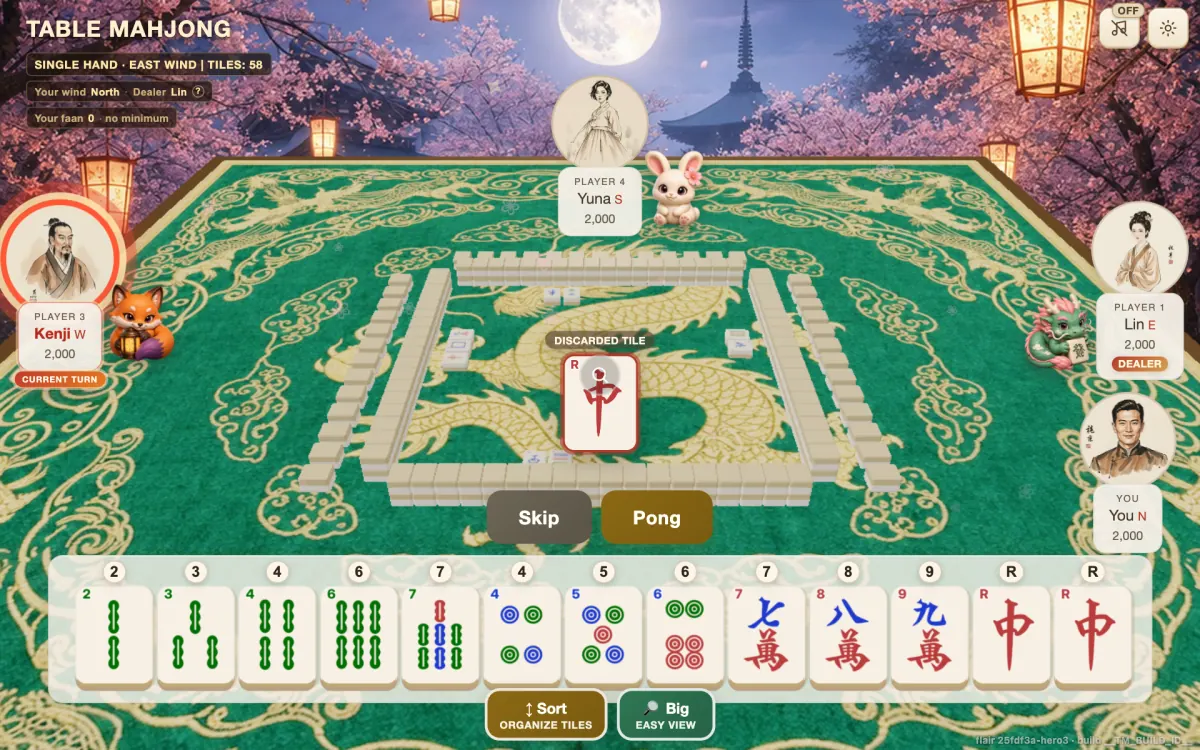
Pong is offered because you hold two Red dragons. -
Claim a Chow from the player on your left
A Chow is three in a row in one suit. You can only Chow the tile the player on your left just discarded, because you play straight after them.
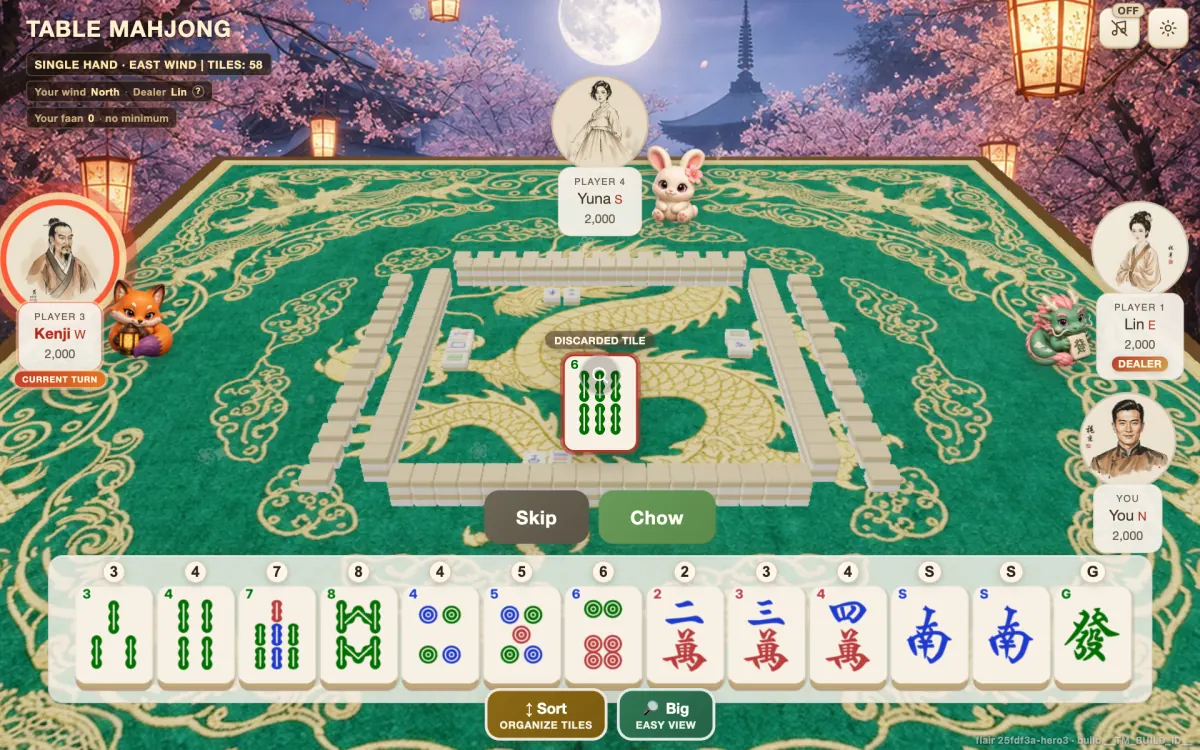
6 Bamboo completes 6-7-8, so Chow is offered. -
Make a Kong with four of a kind
Holding three of a tile and someone discards the fourth? Claim a Kong. You can also declare a Kong from your own hand on your turn. After any Kong you draw a replacement tile.
-
Finish four sets and a pair, then call Mahjong
A winning hand is four sets (Chows, Pongs or Kongs) and one pair. When a discard or your own draw completes it, and it meets the table's minimum faan, a Mahjong! button appears.
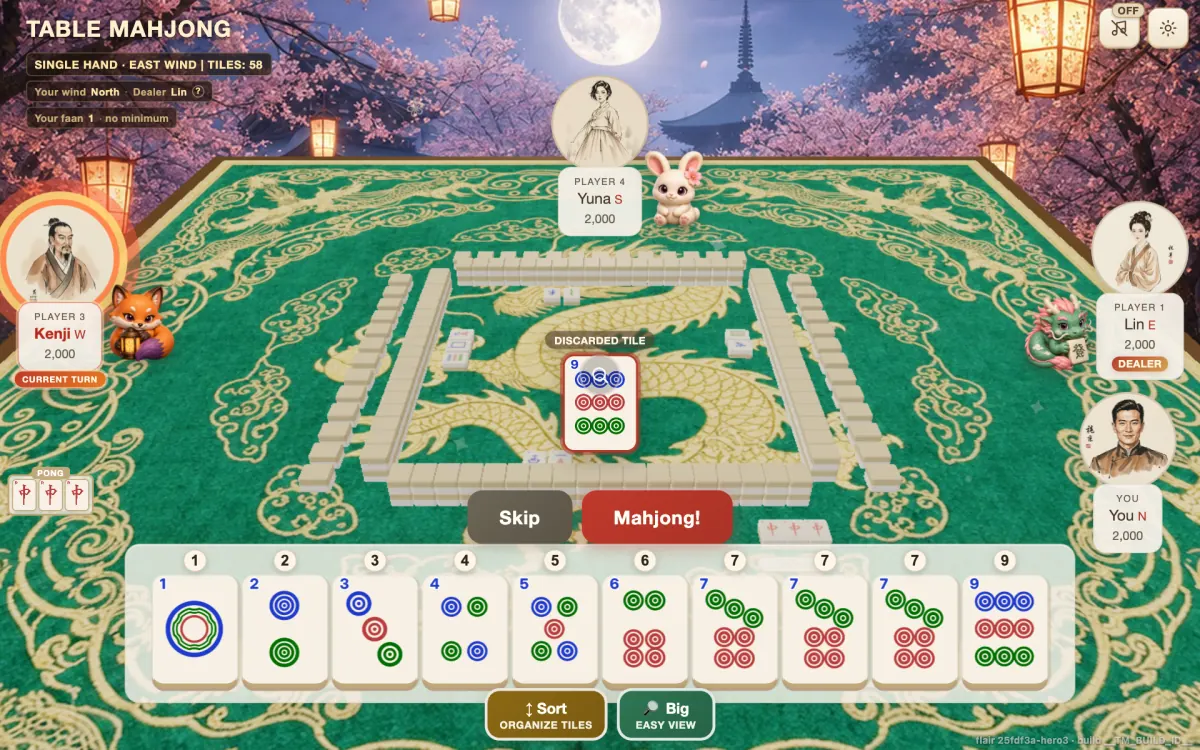
9 Dots finishes the hand: tap Mahjong! -
Read your faan and the payout
The win screen lays out your sets and counts each faan line. Points are 8 × 2 to the power of the faan for each share, and the winner collects three shares. Then start the next hand or a new match.
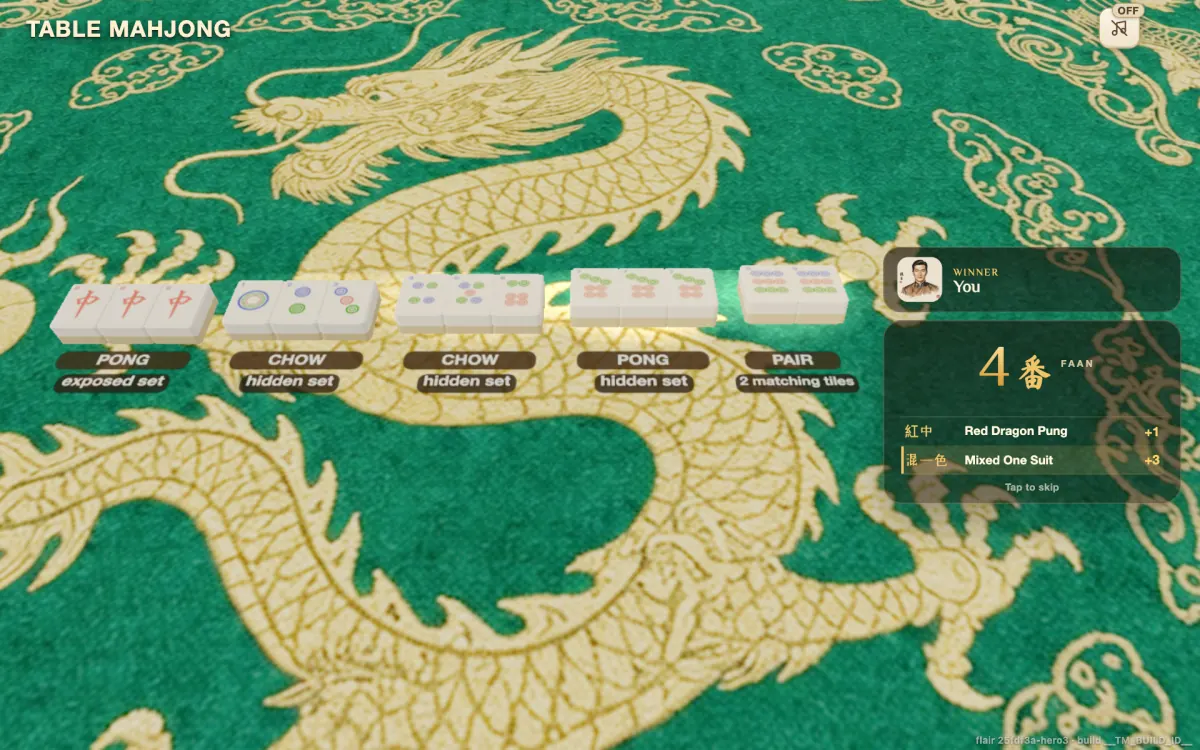
4 faan: Red Dragon Pung +1 and Mixed One Suit +3.
Beginner tips
- Keep pairs early. A pair can become a Pong from anyone's discard, and you need one pair to finish.
- Let go of lone honours. A single wind or dragon you have no partner for is hard to use. Discarding it early is usually safe, unless it is your seat wind or the round wind.
- Watch the discards. If three of a tile are already out, the tile you are waiting on is nearly gone. The magnifier lets you inspect every discard and exposed set.
- Do not claim everything. Each claim exposes a set and loses the concealed-hand faan. Skip claims that do not move you toward a win.
- Mind the minimum. At an HK 3 Faan table a cheap hand cannot win. The "Your faan" counter in the header tells you how close you are. See minimum faan.
How scoring works, briefly
Each pattern in your winning hand adds faan: 1 for a self-draw, 1 for a concealed hand, 1 for each dragon Pong, flower or scoring wind Pong, 1 for all Chows, 3 for all Pongs or mixed one suit, and 7 for pure one suit. A hand with none of these is a chicken hand worth 1. Named hands are worth more: Small Three Dragons 5, Small Four Winds 6, Great Three Dragons 8 and All Honours 10, and limit hands such as Nine Gates or All Concealed Pongs score the full 13. Thirteen Orphans and Seven Pairs are not winning hands yet; they are coming soon. Points per share are 8 × 2faan, capped at 13 faan. Worked examples are on the rules and scoring page.